

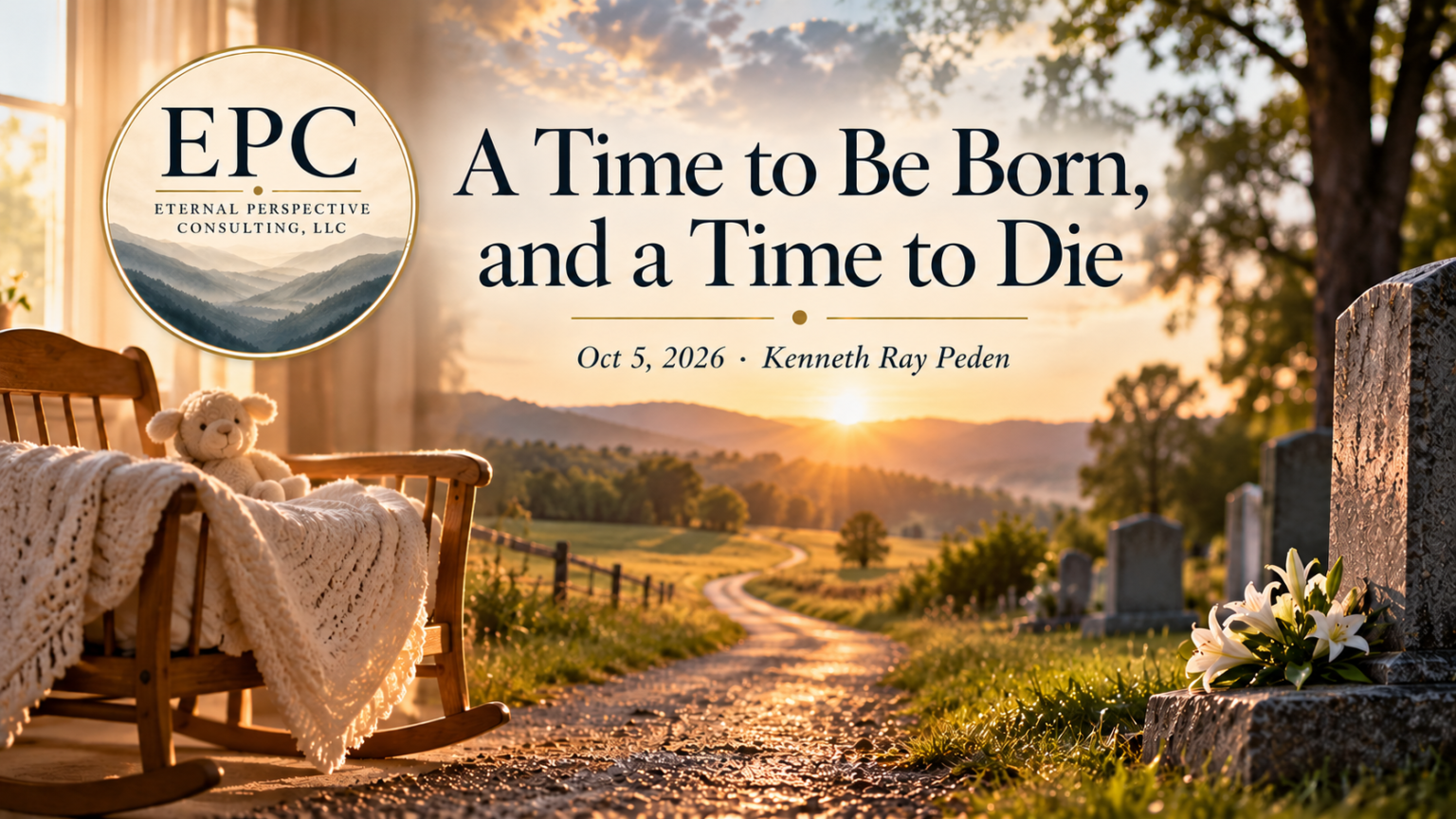
Walk through any cemetery and you’ll see the same thing carved on stone after stone. A name. A date of birth. A date of death. And between those two dates, a small dash.
That little mark doesn’t look like much. But it stands for everything. Every first step, every hard day at work, every late night by a hospital bed, every Sunday morning, every laugh around the supper table. The whole life lives in the dash.
To Everything a Season
Solomon opens one of the best-known passages in the Bible this way:
“To everything there is a season, a time for every purpose under heaven.”
ECCLESIASTES 3:1, NKJV
The words are worth slowing down for. The Hebrew word for “season” is zeman (Strong’s H2165). Strong’s describes it as an appointed occasion, a time that has been set. The word for “time” is eth (Strong’s H6256), the ordinary word for a moment or a due season. And “purpose” is chephets (Strong’s H2656), a word that speaks of delight or desire, a matter someone has in mind.
Put together, Solomon is saying more than “things happen.” He’s saying life is made of appointed seasons, and Someone has a purpose in mind for each one. Then he names the first pair, and he starts at the very edges of life:
“A time to be born, and a time to die.”
ECCLESIASTES 3:2, NKJV
A Time to Be Born
There may be no happier room on earth than a delivery room. The waiting is over, the pain is forgotten, and a family meets someone they will love for the rest of their lives. Jesus Himself used that moment to describe joy:
“A woman, when she is in labor, has sorrow because her hour has come; but as soon as she has given birth to the child, she no longer remembers the anguish, for joy that a human being has been born into the world.”
JOHN 16:21, NKJV
That birth was no accident. David wrote that God knew him before anyone else did: “Your eyes saw my substance, being yet unformed. And in Your book they all were written, the days fashioned for me, when as yet there were none of them” (Psalm 139:16, NKJV). Before the first date is ever carved in stone, God has already seen the life that will fill the dash.
A Time to Die
The other end of the dash feels very different. I have stood in a lot of hospital rooms and at the side of many hospice beds over the years. I’ve sat with families as the breathing slowed, and I’ve walked that road with my own father. The joy of the delivery room is replaced by worry, waiting, and grief.
Scripture doesn’t pretend this season away. “It is appointed for men to die once, but after this the judgment” (Hebrews 9:27, NKJV). The same God who appointed a time to be born has appointed a time to die.
But for the child of God, sorrow is not the last word. Paul wrote to grieving Christians “concerning those who have fallen asleep, lest you sorrow as others who have no hope” (1 Thessalonians 4:13, NKJV). Notice he didn’t say we won’t sorrow. He said we don’t sorrow the way the world does. And the Psalmist adds a line that has comforted many families at a graveside: “Precious in the sight of the LORD is the death of His saints” (Psalm 116:15, NKJV).
The Dash in Between
Here’s where Solomon surprises us. A few chapters later he writes:
“A good name is better than precious ointment, and the day of death than the day of one’s birth; better to go to the house of mourning than to go to the house of feasting, for that is the end of all men; and the living will take it to heart.”
ECCLESIASTES 7:1–2, NKJV
How could a funeral be better than a birthday party? Because at a birth, the dash hasn’t been written yet. At a funeral, we see what the dash held. A good name is built one day at a time, in the space between those two dates. And the funeral is where “the living will take it to heart.”
Linda Ellis wrote a poem many of you have heard read at memorial services, called The Dash. Her point is simple and true: what matters most isn’t the dates on the stone, but how we spent the time in between. Moses prayed the same thing thousands of years earlier: “So teach us to number our days, that we may gain a heart of wisdom” (Psalm 90:12, NKJV).
The dash is also shorter than we think. James asks, “For what is your life? It is even a vapor that appears for a little time and then vanishes away” (James 4:14, NKJV). None of us knows how long our dash will be. That’s exactly why it matters how we live it.
Redeeming the Time
Paul gives us a practical word for life in the dash:
“See then that you walk circumspectly, not as fools but as wise, redeeming the time, because the days are evil.”
EPHESIANS 5:15–16, NKJV
Two Greek words stand out. “Redeeming” is exagorazo (Strong’s G1805), meaning to buy up, to rescue something from loss. “Time” here is kairos (Strong’s G2540). Vine’s points out the difference between kairos and the more common chronos. Chronos is time as it passes on the clock. Kairos is a season or an opportunity, a moment marked by what it holds.
In other words, Paul isn’t telling us to stay busy. He’s telling us to buy back the opportunities in front of us before they slip away. The business owner who keeps putting off the hard decision. The caregiver who hasn’t had a real conversation with her husband in months. The first responder who is home but never quite present. The dash is full of kairos moments, and they don’t wait for us.
Seeing the Dash from Eternity
When life gets heavy, the dash is all we can see. The bills, the diagnosis, the empty chair, the business that isn’t working. Paul knew that feeling, and he knew where to look:
“Therefore we do not lose heart… while we do not look at the things which are seen, but at the things which are not seen. For the things which are seen are temporary, but the things which are not seen are eternal.”
2 CORINTHIANS 4:16, 18, NKJV
Just a few verses after “a time to be born, and a time to die,” Solomon tells us why we long for more than the dash: “He has made everything beautiful in its time. Also He has put eternity in their hearts” (Ecclesiastes 3:11, NKJV). We were made for more than two dates on a stone.
That’s the hope Peter urged believers to be ready to explain: “always be ready to give a defense to everyone who asks you a reason for the hope that is in you, with meekness and fear” (1 Peter 3:15, NKJV). A dash lived with eternity in view is a life people notice. They want to know where the hope comes from.
Living Your Dash
You can’t choose the date on either end of your dash. God holds those. But you can choose how you live the days in between.
If you’re in a season where the big picture has gone blurry, where you’re just trying to get through the week, you don’t have to sort it out alone. Sometimes it helps to sit down with someone who will listen and help you see your life from God’s point of view again. If that would help, I’d be glad to talk.
Kenneth Ray Peden
Senior Consultant
Eternal Perspective Consulting
eternalperspectiveconsulting.com
(903) 699-0973
Kenneth@eternalperspectiveconsulting.com